Book Categories:

One more story for the road?
Not sure where to begin? Compare xianxia, xuanhuan, and wuxia in our short reader’s guide. WholeSaga is preparing carefully edited, complete Chinese fantasy stories in English.
Book Categories:


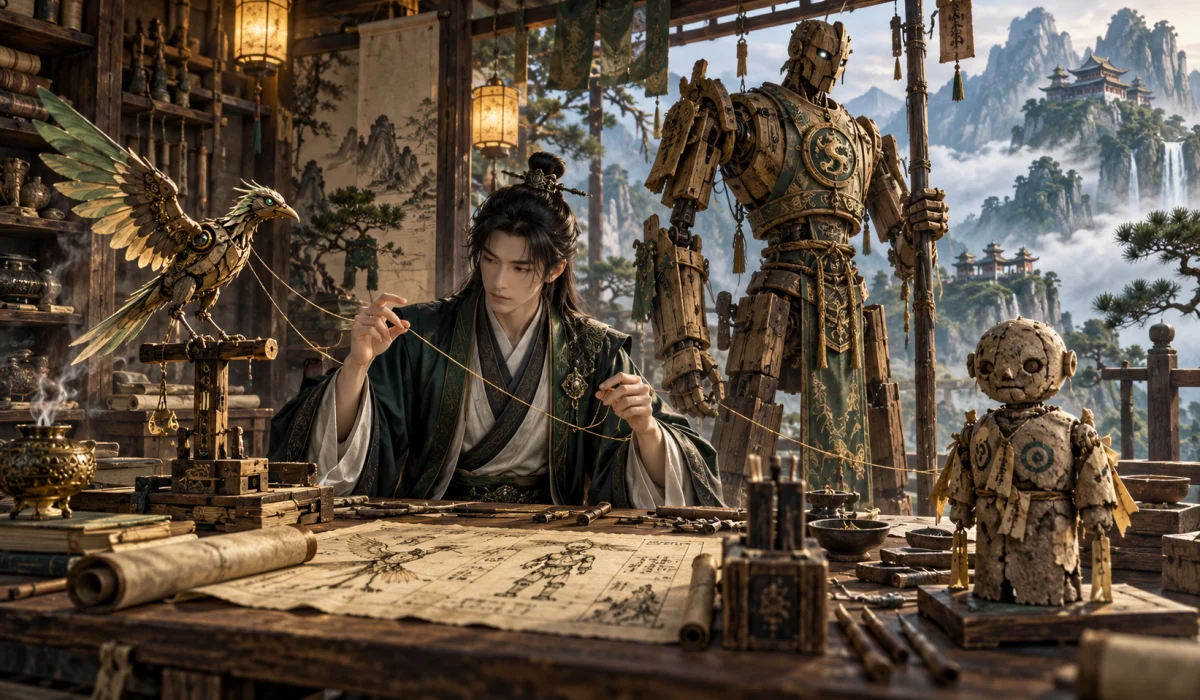
Puppet cultivators in xuanhuan project power through controlled bodies, constructs, corpses, tools, or other story-specific agents. Their central trade-off is separation: they can act in more places or keep their own body away from danger, but control may demand attention, materials, preparation, communication, or trust. No single mechanism applies to every xuanhuan story.
A sword user’s power is usually concentrated where the sword user stands. A puppet specialist can distribute action across scouts, guards, decoys, laborers, or attackers. That distribution changes the shape of a scene. The character may watch several doors, threaten from concealment, or sacrifice an expendable shell instead of a living ally.
Xuanhuan is a broad and hybrid field rather than a single ruleset. Cambridge scholarship describes xuanhuan as “mysterious fantasy” associated with Chinese philosophy, folklore, and mythology, while also placing it within overlapping Chinese fantasy labels. China Writers Association criticism likewise emphasizes the form’s mixing of martial arts, mythology, science fiction, games, and other materials. That openness is precisely why puppet mechanisms should be read as local inventions, not inherited laws.

Puppet control limits in cultivation novels often begin with attention: having five bodies does not necessarily mean performing five perfect actions. A story can make command itself scarce. The controller may issue only simple instructions, lose detail over distance, or struggle when several puppets encounter surprises at once.
Original micro-example: Sera sends three clay birds through a ruined palace. One maps the halls, one follows a heat trail, and one guards the exit. When all three signal danger together, she must choose which viewpoint to inhabit. The abandoned bird continues its last order—and quietly leads an enemy back to her refuge.
The mistake comes from divided attention, not from arbitrary failure. Puppetry gives Sera reach, while the control model exposes her priorities under pressure.
Other stories may grant puppets considerable autonomy. That reduces moment-to-moment control but introduces a different question: how much judgment can the cultivator delegate? A construct that interprets “protect me” too broadly may endanger bystanders. One capable of refusing an order may be a partner rather than equipment.
Maintenance costs for cultivation puppets turn free-looking numbers into long-term choices. A damaged joint needs repair. Specialized materials must be found or purchased. A power source may run down. Concealed weapons may require ammunition. A stolen puppet may reveal its maker’s techniques.
Original micro-example: Orrin wins a canyon ambush by allowing his iron guardian to take the killing blow. Two chapters later, he reaches a frozen pass without the guardian’s weatherproof core. The earlier victory has become a travel problem, and replacing the core would consume the metal promised to a village.
Maintenance gives consequences a memory. Damage persists beyond the battle, and resource choices connect action scenes to journeys, debts, workshops, and alliances. A puppet specialist can be formidable without making every deployment cheap.
Remote action can protect the cultivator’s body and conceal their location. It can also delay information or weaken verification. Is the scout seeing an enemy, an illusion, or corrupted instructions? Did the puppet stop because it was destroyed, disconnected, or captured? The farther the agent travels, the more room the story has for uncertainty.
That uncertainty makes counterplay possible. An opponent can feed a scout false evidence, imitate a command, trace the link, isolate one unit, or force the controller to reveal themselves. These are examples of narrative countermeasures, not a claim that every fictional puppet uses a hackable link.
Sentient puppet ethics in xuanhuan stories begin with what the controller considers a person. A crafted wooden guardian, an inherited automaton, a copied memory, and a coerced living body create very different moral stakes. The text may treat one as a tool and another as enslavement. Readers should follow what the story establishes about consciousness, consent, and identity.
Puppets can also act as externalized relationships. A repaired guardian may preserve a teacher’s lessons. A disposable swarm may reveal that its owner values efficiency over beauty. A body double may let a ruler survive assassination while making every public appearance suspect. The mechanism does plot work because it expresses the controller’s habits and fears.
Ask five practical questions:
The answers reveal both the tactical ceiling and the emotional center. They also prevent assumptions imported from another novel from flattening a new system.
To place puppet-focused stories within the wider field, compare the major cultivation novel genres rather than treating xuanhuan as a single ruleset. The guide to cultivation terms can also clarify nearby concepts while preserving each novel’s own control system.
No. A story may use thought, commands, seals, mechanisms, spirits, autonomy, or an entirely different invention.
Not necessarily. Distance fighting can be a specialization without implying a frail body.
Only if the story says so. Their materials, agency, origin, and ethical meaning may differ sharply.
Puppets may be expendable, specialized, secret, or available where allies are not. But they can also lack judgment, demand maintenance, and isolate the controller.
Compare these repair and ownership costs with those of cultivation artifacts and treasures elsewhere in the genre. To compare two ways a story can distribute control across a scene, look at how formation arrays in xianxia shape access and movement.