Book Categories:

One more story for the road?
Not sure where to begin? Compare xianxia, xuanhuan, and wuxia in our short reader’s guide. WholeSaga is preparing carefully edited, complete Chinese fantasy stories in English.
Book Categories:


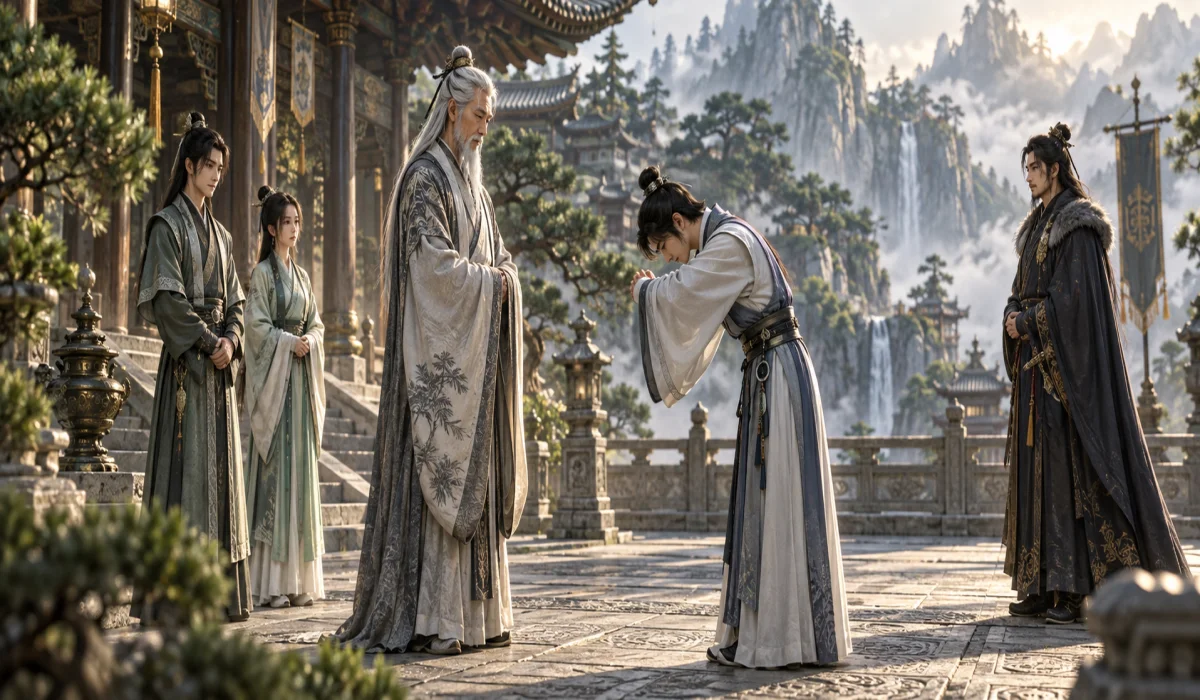
To understand how Chinese honorifics work in xianxia, read them as clues to how one character positions another in a relationship—as teacher, senior fellow disciple, family member, respected guest, officeholder, or social superior. They do not reliably state cultivation level, and their force can change with context, setting, and translation.
English often lets a name do most of the work in dialogue. Chinese offers many combinations of surnames, roles, kinship words, titles, and familiar forms. Kansas State University’s Chinese pragmatics materials list title, surname-plus-title, full name, kinship term, and endearment among common address strategies.
That variety gives fiction a compact way to show relationships. Imagine a character switching from “Sect Leader Zhao” to “Uncle Zhao.” The change might suggest familiarity, an alliance, mockery, or a claim of belonging. Tone, narration, and the characters’ history help establish which reading fits.

In translated cultivation fiction, shifu often appears as “Master.” Two Chinese spellings can sit behind the same pinyin:
A corpus-based study of the two forms of shifu documents differences in their historical and modern frequency. For a reader, the key lesson is not to infer a power tier from the English word “Master.” A disciple’s shifu may be politically weak, injured, retired, or less powerful than another teacher. The address identifies a relationship.
Some translations use shizun (师尊 / 師尊) for an especially reverential “honored master.” A novel may distinguish shifu and shizun, use only one, or vary by speaker. Follow the edition’s pattern instead of forcing a universal hierarchy.
When asking “what do shixiong and shidi mean,” start with the training family. The shi- forms combine a teacher or lineage marker with sibling language:
“Senior” and “junior” normally concern position within a teaching relationship—often entry order or recognized lineage seniority—not raw combat strength. A gifted shidi can defeat his shixiong and still address him as shixiong. Different sects or translations may establish other rules, so the novel remains authoritative.
These expressions also show why literal English can mislead. “Senior Brother” need not mean blood relation, and “Martial Brother” may sound more combat-specific than the underlying relationship. A Nanjing University study of generalized Chinese kinship terms documents their use for non-relatives in an academic setting. Xianxia can adapt that relational vocabulary into fictional institutions, though each novel defines its own lineage and offices.
Words rendered as Elder, Sect Leader, Palace Master, Hall Master, or Patriarch usually name an office, institutional role, or recognized standing. They may correlate with power because organizations choose strong leaders—but the title itself is not a realm.
Translation increases ambiguity. “Senior” may render an older person, a predecessor in training, or a respectful qianbei (前辈 / 前輩). “Master” may represent a teacher, owner, household head, or supreme practitioner. When a title matters, look for what the person controls: disciples, a hall, property, ritual authority, or decision-making. That is more reliable than the English capital letter.
Gongzi (公子) is often translated as “young master,” “young lord,” or the archaic “childe.” In historical or fantasy-flavored dialogue it commonly marks a young man of status or offers polished respect. So, does gongzi indicate cultivation rank? No: it does not prove that he holds a specific cultivation rank—or even that the speaker knows his real status.
Likewise, a surname plus role can preserve distance: “Elder Chen,” “Teacher Li,” or “Physician Wang.” Modern Chinese teaching materials show the same broad pattern in examples such as surname plus laoshi (“Teacher/Professor”). Fictional settings elaborate the pattern with invented offices.
Modern Chinese names conventionally place the family name before the given name. A University of California, San Diego reference explains this name order and the historical use of courtesy names. A character may have a ming (名), or given name, a zi (字), or courtesy name, and a hao (号 / 號), an adopted appellation. These can all refer to the same person.
Xianxia may borrow any of these practices, mix periods, or invent a local convention. Do not assume every alias is a courtesy name. Instead, note who uses which name. A personal name can express intimacy in one scene and contemptuous overfamiliarity in another; a title can express sincere respect or icy distance.
When an unfamiliar form appears:
For the offices and privileges that sit behind these relationships, see our guide to inner and outer disciples. Use Cultivation Realms Explained for advancement systems and the cultivation glossary for other unfamiliar vocabulary.
No. It usually marks a senior male fellow disciple within a teaching lineage, not a guaranteed difference in combat power.
Not always. When readers ask “are shifu and shizun the same,” the text’s usage is the deciding evidence. Both can address a teacher or master, but a story or translation may give shizun a more reverential tone.
Usually not. The answer to “does gongzi indicate cultivation rank” is no: it commonly marks social status or polished respect, not a realm, though a speaker may use it for someone who is also powerful.
Chinese kinship vocabulary can extend beyond literal family. In fiction, such usage may express age relation, familiarity, courtesy, alliance, or a deliberately claimed bond.