Book Categories:
One more story for the road?
Not sure where to begin? Compare xianxia, xuanhuan, and wuxia in our short reader’s guide. WholeSaga is preparing carefully edited, complete Chinese fantasy stories in English.
Book Categories:


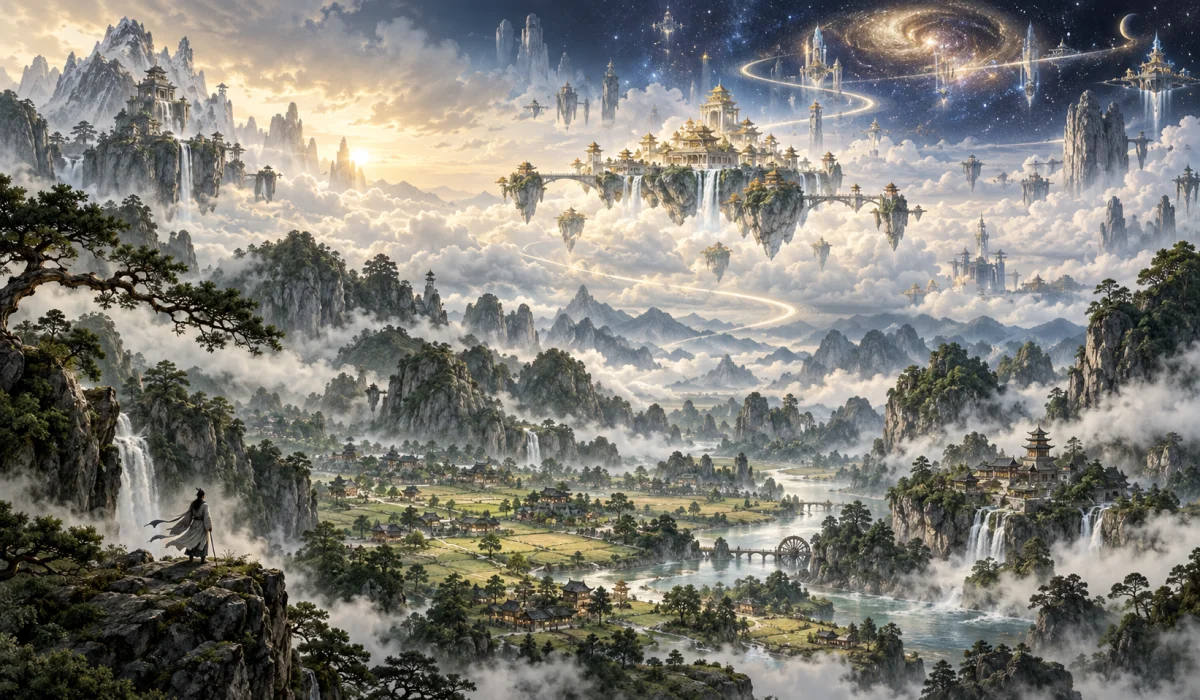
How xianxia cosmology works depends on the story-specific arrangement of places that make up its universe: mortal worlds, heavens, immortal domains, underworlds, secret realms, star fields, or other planes. Ascension may mark movement between those spaces, a change of status or jurisdiction, or both. It is not automatically the same thing as advancing through cultivation stages, and no single map applies to every novel.
The difference between cultivation realms and world realms can be obscured because English translations often use realm for two different ideas. A “Foundation Establishment realm” may describe a character’s level of cultivation, while an “Immortal Realm” may be a place with geography, inhabitants, and borders. Context tells you which meaning is intended.
Try replacing realm with a question. If you can ask “Where is it, who lives there, and how do people enter?”, the term probably names a spatial layer. If you can ask “What abilities does it grant, and what comes before it?”, it probably names a cultivation stage. Some novels connect the two, but they remain different parts of the design.
The WuxiaWorld general glossary presents the mortal world, heavens, and underworld as recurring cosmological language while repeatedly qualifying its descriptions as conventions found in some novels. That caution is essential: a story may borrow familiar names and then reorganize them.
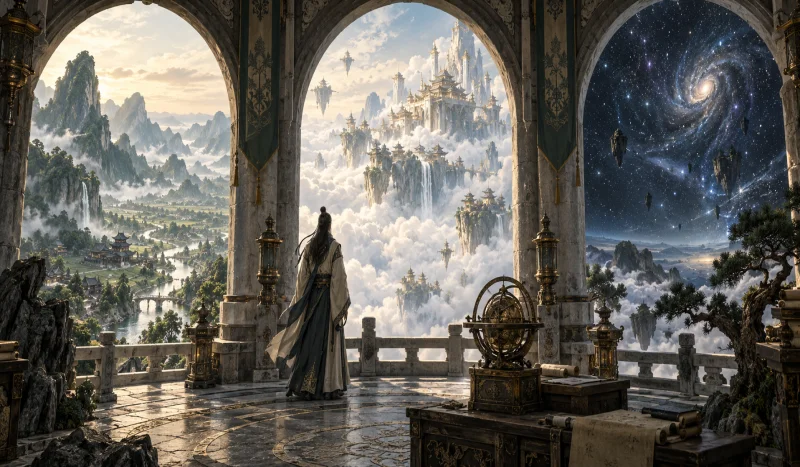
Readers do not need a complete diagram on chapter one. Instead, note every boundary the story establishes. A sea may divide continents. A barrier may seal a lower world. A teleportation formation may connect distant domains. An ascension passage may open only under particular conditions.
For each boundary, record four facts:
Those details reveal more than a list of grand names. They show whether the universe is a ladder, a network, nested spaces, scattered worlds, or something stranger.
Original example: The Reed World is enclosed inside an ancient bell. Ascendants do not rise into the sky; they reach the bell’s rim and cross into the foundry where thousands of world-bells are repaired. The “upper realm” is therefore outside, not literally above.
This invented example shows why spatial language should not be taken too literally. “Higher” can signal prestige or narrative scale even when the physical route is sideways.
How ascension works in xianxia novels varies, but the move often ends one local order and introduces another. A protagonist who was a famous sect leader may arrive as an undocumented outsider. Valuable currency may become common material. Techniques once treated as legendary may be basic instruction. The move preserves the character’s history while resetting their social position.
That reset can expand several story dimensions at once:
The important point is narrative expansion, not an automatic increase in explosion size. A new plane can create legal, cultural, linguistic, or logistical problems even before anyone fights.
A mortal-to-immortal ladder is familiar, but xianxia cosmology can take many forms. Secret realms may be temporary pockets inside a larger world. An underworld may process souls rather than sit at the bottom of a power hierarchy. Star domains may be peer territories rather than successive levels. A “small world” may refer to limited size, weak laws, political dependence, or merely a name inherited from its founders.
Title-specific glossaries make the variation visible. WuxiaWorld’s Lord of All Realms glossary lists multiple named realms inside a broader domain, while its First Immortal of the Sword glossary uses world- and star-realm language alongside that novel’s own advancement system. These are examples of individual maps, not templates to impose elsewhere.
When a translation shifts among world, realm, domain, plane, and heaven, follow the relationships established in the story. Repeated proper names, travel rules, and political control are stronger evidence than the English noun alone.
Cosmic expansion is clearest when you track continuity. Which promises survive ascension? Can messages reach the old world? Do enemies pursue the protagonist through the same gate? Does time pass at the same rate on both sides? Can resources from one layer disrupt another?
A simple reading note can use three columns: place, route, and unresolved tie. For example: “Cloud Basin — broken ascent platform — sister still rebuilding the gate.” That line captures geography, access, and emotional stakes without requiring a giant lore chart.
This method also prevents a common confusion: a character can become stronger without leaving their world, or cross into a new world without immediately mastering its power system. Advancement and travel may intersect, but one does not define the other.
If spatial labels are starting to blur with advancement language, our guide to cultivation terms separates common concepts without imposing a universal ladder. For the broader tradition behind immortal worlds and ascension, see what xianxia is.
No. Names, quantities, relationships, and travel rules are determined by each novel.
Mortal and immortal realms in xianxia may be described as lower and upper worlds, but “above” can express status rather than literal vertical geography. Follow the story’s route.
No. A breakthrough changes cultivation. Ascension may change location, status, or cosmic jurisdiction. A novel can make them happen together.
Sometimes. They can be sealed regions, pocket spaces, ruins, trial grounds, or independent worlds. The text’s access rules determine their role.